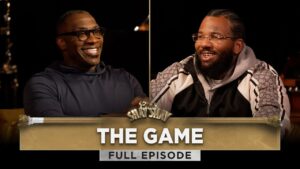
Shannon Sharpe’s latest sit-down in this episode of Club Shay Shay features West Coast mainstay The Game, whose career spans multiple eras of hip-hop and whose influence is closely tied to Los Angeles’ resurgence in the mainstream during the mid-2000s. The wide-ranging conversation traces The Game’s personal history, professional milestones, public controversies, and continued evolution as an artist.
The discussion begins with The Game revisiting his upbringing, marked by instability, addiction within his household, and exposure to violence at an early age. After entering foster care following reports of abuse, he describes building emotional barriers that eventually led him into gang life. Those formative experiences shaped both his worldview and his music, grounding much of his work in survival and realism.
He recounts navigating the streets of Compton, serving jail time, and surviving a near-fatal shooting that left him in a coma after being hit five times. That incident, he explains, became a turning point that reframed his priorities and redirected his focus toward music with renewed urgency.
The conversation then shifts to his industry breakthrough, beginning with his signing to Dr. Dre. The Game outlines Dre’s demanding creative process and attention to detail, crediting that environment with sharpening his discipline as an artist. He also reflects on joining G-Unit and forming an early bond with 50 Cent, a partnership that played a major role in launching his debut album and establishing his national presence.
Sharpe and The Game revisit the fallout from that alliance, including the well-documented feud, the shootout tied to the conflict, and the unexpected intervention by Michael Jackson, who helped de-escalate tensions. Looking back, The Game frames the episode as a formative lesson in fame, ego, and the long-term consequences of public disputes.
As the discussion moves into modern hip-hop, The Game offers perspective on contemporary rap beefs, reconciliation with former rivals, and his complicated history with Kanye West. He addresses rumors that circulated during that period and reflects on how public narratives often overshadow reality in the industry.
Financial growth and missteps also emerge as a central theme. The Game speaks about early money mistakes, the pressures of rapid success, and his decision to reinvest in his community by purchasing homes on his childhood block. He also reflects on the loss of Nipsey Hussle, describing the impact of his death as deeply personal and comparable to earlier generational losses in hip-hop.
The conversation revisits The Game’s relationship with Kendrick Lamar, including nearly signing him early in his career and later publicly passing him the torch alongside Snoop Dogg and Dr. Dre. He explains the reasoning behind that moment and reflects on hearing Kendrick reference him years later, framing it as validation of mutual respect rather than missed opportunity.
Sharpe also prompts The Game to weigh in on West Coast lineage, his long-standing issues with Suge Knight, and his role in safely bringing Drake to Compton during a volatile moment. These anecdotes highlight The Game’s position as both a participant in and witness to multiple hip-hop eras.
He discusses recording with Eminem, their subsequent disagreements, and how he views his past diss records today. He addresses controversial comparisons, including labeling NBA YoungBoy as a modern-day Tupac, his views on Lil Wayne’s legacy, and the realities of paying for features. He also reflects on nearly signing with Birdman and the business lessons gained from those negotiations.
Beyond his own catalog, The Game speaks on writing music for other artists, adapting to the streaming era, and identifying what he considers the greatest rap album of all time. He also touches on navigating rumors, potential exhibition fights, and his appearance on the dating show Change of Heart, acknowledging how those moments shaped public perception.
The latter portion of the conversation turns inward, focusing on fatherhood, co-parenting, discipline, and protecting his children, particularly his daughters, from the pressures of social media. He reflects on loyalty, betrayal, mental health, and the personal symbolism behind his Kobe Bryant tattoo.
As the interview concludes, The Game outlines his current creative direction, promoting an upcoming DJ Drama mixtape and his next studio album. He explains the distinction between his approach to mixtapes versus albums, positioning each as a different expression of his artistry at this stage of his career.